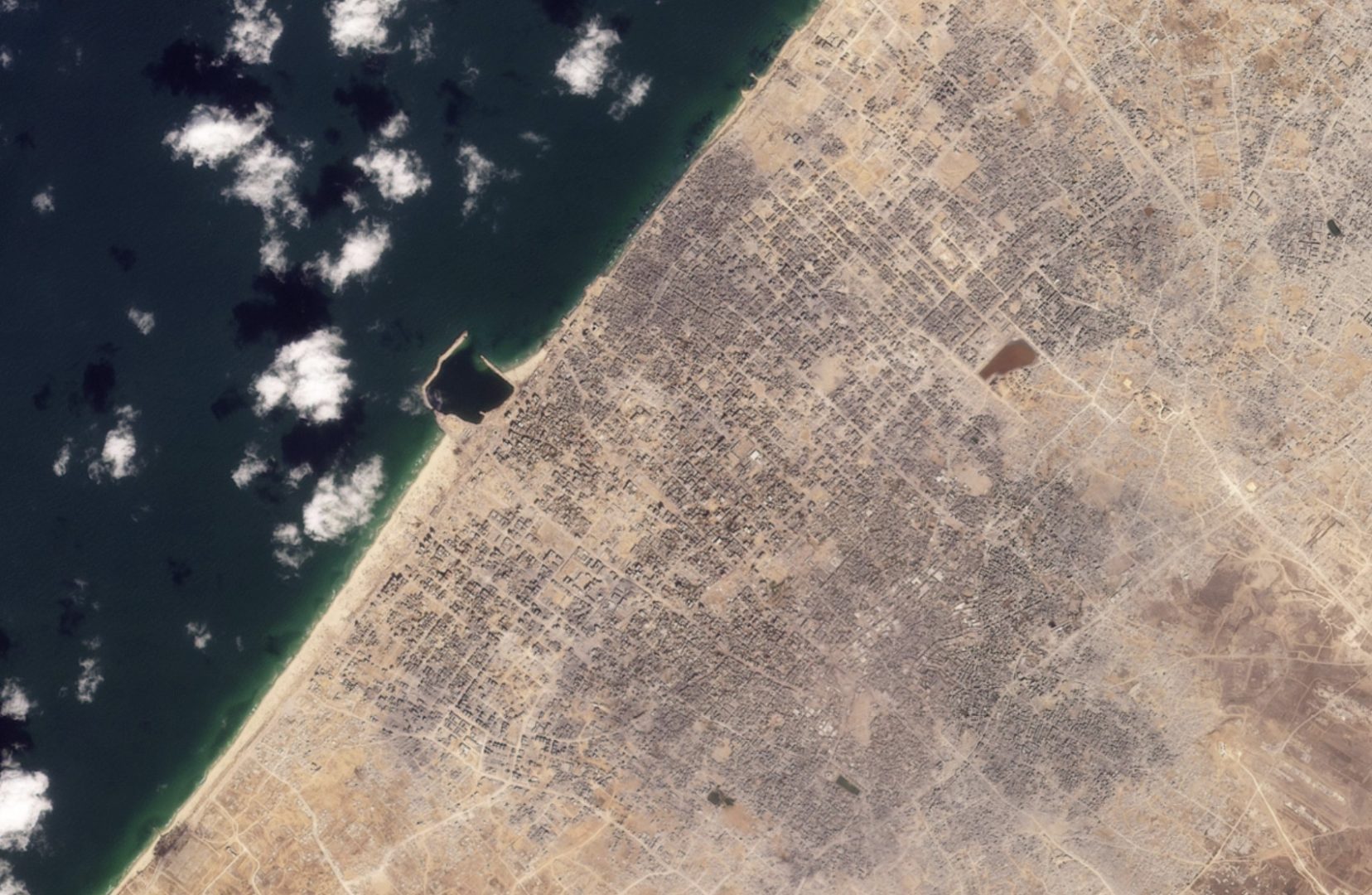
In October 2025, we published in Italian the following article here on FACTA, in collaboration with IrpiMedia, presenting data and studies on the widespread destruction in the Gaza Strip. Since then, further research has been conducted, confirming that the toll is and remains horrific and devastatingly heavy.
We will continue our dedicated work on this issue.
However, beyond the staggering numbers, the central priority is to keep the world's attention deeply focused on Gaza. Since the beginning of this so-called truce, global awareness and focus have dropped alarmingly, also due to the conflict between Israel and Iran, endangering the entire region and overshadowing the ongoing humanitarian catastrophe in the Strip.
Above all, we must not in any way allow the unprecedented scale of destruction and extreme pollution to become tools and weapons that favour the forced displacement of Palestinians from the Strip. The weaponisation of the environment through the deliberate collapse of water and sanitation systems, the severe contamination of soil with toxic chemicals, and the vast accumulation of hazardous debris has created an ecological catastrophe that threatens to make the land uninhabitable for generations. This spatial cleansing cannot be allowed or normalised as a method to uproot the population.
What is urgently needed, on the contrary, is to guarantee the return of life to the Strip: restoring local food production, ensuring the purification of water, and rehabilitating the essential infrastructure necessary for survival.
Nothing in the Gaza Strip is functioning. Despite a frail US-mediated truce, almost all buildings have been destroyed, along with all infrastructure. Managing basic resources like water and land has become arduous.
The ongoing genocide in Gaza – in which more than 60,000 people have lost their lives so far – is compounded by the destruction of the Strip’s biosphere, a process that can be referred to as ecocide.
Producing food, using water, breathing clean air will be extremely difficult for anyone who lives there, regardless of any future development plans. This is expected to negatively affect human and non-human life in the area for years to come.
It’s not yet possible to determine the scale of the ecocide underway in Gaza and partly in the West Bank, because it would require complex on-the-ground verification. But scientists and local experts have already been chiming in on the level of destruction that has been wreaked on life in the area for the past two years.
According to Ghassan Abu-Sittah, a Palestinian-British surgeon, this has been the first true war on the biosphere, or the outer layer of the Earth’s surface on which animal and plant life develops.
All infrastructure necessary for life has been eliminated: healthcare systems, water facilities, institutions that generate and transmit knowledge and those that feed people, like fields, agricultural production facilities, and even trees. It may be less intuitive and less immediately visible, but eroding the systems that sustain a community ultimately erodes its future.
What is meant by Ecocide
There is still no universally accepted legal definition of the crime of ecocide, despite it being in the public domain for 50 years. The first to invoke the concept was the American biologist Arthur Galston in 1970. Two years later, the Swedish Prime Minister Olof Palme mentioned it in a speech at the United Nations.
However, serious discussions about the issue have only gained momentum in recent years, driven by growing global environmental awareness and mounting scientific evidence linking conflict to the climate crisis.
Since 2017, Stop Ecocide International, an international organisation founded by Scottish lawyer Polly Higgins and comprising jurists and diplomats from around the world, has worked to develop a proposal for a legal framework that could be recognised at the international level.
In 2021, the group coordinated a panel of twelve independent experts proposing an amendment to the Rome Statute of the International Criminal Court that defines war crimes. If the amendment is ratified, the Statute’s Article 8 would also expand and strengthen the definitions of genocide and crimes against humanity, which were developed after World War II.
At present, Article 8 explicitly refers only to the destruction of buildings dedicated to science and education and to medical facilities, without any reference to the “non-anthropic” environment.
According to Stop Ecocide International, whose definition is currently adopted by several international organisations, ecocide encompasses all unlawful or wanton acts intentionally carried out despite the likelihood of causing severe, widespread, or long-term damage to the environment.
Necessary conditions to define ecocide include wantonness, meaning a reckless disregard for damage that is clearly excessive in relation to anticipated social and economic benefits; severity of harm, meaning negative environmental impacts, destruction or degradation of environmental components, and serious repercussions for human life or natural, cultural, and economic resources; widespread damage, extending beyond a limited geographic area and affecting an entire ecosystem, many species, and large numbers of people; long-term damage, meaning irreversible harm or harm that cannot be remedied within a reasonable time frame. Finally, there’s damage to the environment as a whole, the biosphere, cryosphere, lithosphere, hydrosphere, atmosphere, and even outer space.
The major innovation of this approach is the introduction of a vision that is not exclusively anthropocentric.
The destruction of knowledge
In April 2024, independent experts of the United Nations Human Rights Council spoke of “scholasticide” within the war in Gaza. The term refers to the intentional mass destruction of an education system. It was coined in 2009 by British political scientist Karma Naboulsi during Israel’s 2008-2009 attack on Gaza (Operation Cast Lead). It was later used in 2011 by the UN Humanitarian Coordinator for Iraq, Hans-Christof von Sponeck, to describe the impact of the US invasion of Iraq on the country’s education system.
Several academic networks - from the International Association of Genocide Scholars to Academics Against the War in Palestine, as well as informal networks that have issued appeals and organised protest initiatives in recent months - have invoked this term to describe what is happening in Gaza.
Scholasticide can be understood as the combination of several intents: firstly, the deliberate destruction of cultural heritage. Secondly, the killing, injuring, or systematic incarceration of education professionals. Thirdly, the closure of spaces dedicated to education, or their use as military bases.
In the first six months of the war alone, 60% of the Gaza Strip’s educational facilities, including 13 public libraries, were damaged or destroyed.
Of the seven universities that existed, which together comprised 21 campuses, little remains standing. By September 2024, eleven campuses had been moderately or severely damaged, and seven completely destroyed. More than 60 university buildings were entirely razed.
Among the earliest attacks were the bombings of the Islamic University of Gaza and Al-Azhar University. Al-Israa University and Al-Quds Open University were completely destroyed after also being used as military bases and temporary detention centres. University College of Applied Sciences and Al-Aqsa University were bombed while sheltering displaced Palestinian civilians.
Since the start of the war, more than 650,000 students have stopped attending school, and 87,000 have been out of universities, according to updated data published in the latest UN Office for the Coordination of Humanitarian Affairs (OCHA) situation report.
Figures from Gaza’s Ministry of Education, cited by OCHA, record over 16,300 students and 725 teachers killed, and more than 24,000 students and 3,080 teachers injured. These numbers would undoubtedly have been worse had children and young people continued to attend school. The suspension of all educational activities, decided by Gaza’s Ministry of Education in October 2023, was intended to prevent schools and university classrooms from becoming sites of mass killings, as tragically happened with hospitals.
Overall, nearly 92% of Gaza’s schools (518 out of 564) have been completely destroyed, along with more than 2,300 educational facilities, from kindergartens to university classrooms. Almost 200 sites of artistic and historical value, including mosques and churches, were also destroyed. Gaza’s central archives, which hold 150 years of historical documentation, a key element in Palestinian claims to the land, were also destroyed.
The lack of infrastructure, energy, and connectivity makes research work extremely difficult or nearly impossible. Collecting samples, preserving them, and analysing them becomes a luxury. Even theoretical research is affected: working with a database, for example, requires reliable connectivity and the time and stability needed to analyse, process, and store data.
Zuhair Dardona, a Palestinian parasitologist from the Gaza Strip, is the lead author of a study published in One Health Bulletin with the objective of examining the health and environmental impacts of the war in Gaza through data collection, field visits, and photographic documentation. In the paper, the researcher openly acknowledges the severe difficulty of systematically gathering data due to the conditions he faces. Dardona himself has been displaced and is unable to collect, store, or analyse samples regularly and consistently.
Compromising food security
Israel has compromised Gaza’s food production capacity and food security, several studies show.
Data collected and mapped by London-based group Forensic Architecture in A Cartography of Genocide show that during the first year of the war alone, Israel destroyed more than 70% of agricultural land (104 square kilometres out of 150), including fields and orchards.
The fighting destroyed 83% of Gaza’s vegetation, and around 3,700 greenhouses, almost half of the total existing in Gaza. By October 2024, 47% of water wells and 65% of water tanks had been destroyed or damaged, and no information was available on the condition of 30% of the remaining wells.
According to data from the UN Food and Agriculture Organisation (FAO), by April 2025, the share of destroyed wells had risen to 83%, and to 71% for greenhouses. The Lancet reported in May that the proportion of destroyed water infrastructure had reached 89%.
Forensic Architecture’s data also show a clear correlation between the destruction of agricultural infrastructure and the advancement of Israeli positions in the Strip, including the construction of camps, military outposts, fortifications, and checkpoints.
These constructions likely further degrade soil health, as they are associated with the use of weapons, explosives, and highly polluting materials, which, if not properly remediated, can leave permanent contamination of soil and water. This scenario is compounded by the complete destruction of all waste treatment facilities, which further contributes to progressive and severe pollution.
He Yin of Kent State University and Lina Eklund of Lund University, together with colleagues, analysed PlanetScope satellite imagery comparing land use in Gaza before the war and during the conflict up to January 2025.
Their analysis shows the extent of the devastation to Palestinian agriculture, which, before the war, was able to produce about half of the food consumed in the Strip. To accurately measure the loss of trees and agricultural land, the researchers trained an algorithm to recognise different types of vegetation cover, from lemon trees and olive groves to various crops and greenhouses.
Between October 2023 and May 2025, 90–94% of fruit trees were damaged, as well as 78–98% of forest vegetation, 71–98% of annual crops, and 78–98% of grasslands and pastures, according to Yin and Eklund.
The worst damage occurred in the early phases of the war in northern Gaza, but the areas of Deir al-Balah and Khan Yunis were also heavily affected, the research shows. Given that these data mainly cover the first year of the war, the current situation, after the massive devastation of recent months, is expected to have worsened.
Damage to trees has long-term consequences. Tree crops require five to seven years to be successfully established and around 15 years to reach full production. Considering that most cultivated trees in Gaza were olive trees, a key crop not only for consumption but also for the commercial value of their products, the impact on food security and the entire agricultural value chain is even clearer.
Another long-term factor is the destruction of greenhouses and their covering materials, which makes any reasonable short-term recovery of vegetable production very difficult to imagine.
Growth of annual field crops is easier to restart, but this also requires restoring soil fertility and health.
In Gaza’s current conditions, soil healing would imply extensive remediation to remove toxic substances that are expected to be present as a result of the war, from heavy metals to asbestos, weapon components, and unexploded ordnance. Bringing the earth back to a naturally healthy state would also require greater water availability, another major problem, given that the destruction of water infrastructure has halted irrigation practices.
Water conditions and the ecological footprint of war
Water quality in Gaza has long been a problem. Well before the current conflict, numerous reports and studies highlighted health risks linked to water contamination, not limited to direct water use.
Contamination by heavy metals or asbestos requires precise, costly, and highly rigorous purification practices. Using contaminated water for irrigation only increases pollutant concentrations in the soil, which then enter the food chain and, in turn, affect human and animal health.
Beyond direct war-related pollution, there is now deep concern about severe organic contamination, given the large number of people and animals killed under bombardment whose bodies could not be properly removed and buried.
The systematic destruction of more than half of wastewater treatment facilities increases the spread and prevalence of waterborne diseases, as researcher Brian Perlman and colleagues showed in an analysis of satellite images published in PLOS Global Public Health. Among the most dangerous waterborne diseases is polio, which reared its head in Gaza last year. The epidemic was swiftly contained through a rapid vaccination campaign, supported in this case by Israel due to fears of uncontrolled viral spread beyond checkpoints.
Hepatitis A and various gastrointestinal viruses have also been circulating in Gaza. There is growing concern about the spread of antibiotic-resistant microorganisms, a well-established phenomenon likely linked to heavy metals present in soil and water from munitions residues. Treating such infections becomes far more complex and uncertain, requiring antibiotics that are much more expensive than those commonly available.
Conflict and military operations also have an impact on the climate, and several researchers have attempted to estimate the carbon emissions associated with the war on Gaza.
According to Benjamin Neimark, a geographer and ecologist at Queen Mary University of London, and Frederick Otu-Larbi, an environmental scientist and climatologist at Lancaster University, carbon emissions during the first 120 days of the war exceeded the annual emissions of at least 26 countries. That amounts to between 420,265 and 652,552 tonnes of CO₂ equivalent. By comparison, Italy emitted approximately 375 million tonnes of CO₂ equivalent during all of 2024. The real problem, however, will arise during reconstruction, when emissions are expected to rise dramatically, reaching nearly 32 million tonnes of CO₂ equivalent, according to the researchers.
A war on healthcare
Only about a third of Gaza’s health facilities remain standing today. They are not fully operational and lack supplies, medicines, equipment, and even space. The European Gaza Hospital, the only facility providing cancer surgery, no longer exists. A report published by the British NGO Medical Aid for Palestinians on October 10th 2025 states that “In the past two years, the Israeli military has systematically dismantled Gaza’s healthcare system.”
According to Forensic Architecture, in the first year of the war, 35 of Gaza’s 36 operational hospitals were put out of service at least once. Of these, 31 were directly targeted by bombardment, and 27 out of 36 were located in areas that were evacuated multiple times. Eleven hospitals were besieged at least once, five were besieged twice. Ten hospitals were invaded. Four field hospitals were evacuated and rendered unusable.
As with agricultural infrastructure, Forensic Architecture identified recurring patterns in attacks on hospitals, including invasions of the facilities themselves. The timing of hospital attacks closely coincided with the presence of displaced civilians sheltering nearby, the group said.
Healthcare workers were a specific target of the Israeli military, not merely collateral victims of generic attacks, with destruction and occupation continuing even after hospitals had been rendered inoperable.
Maternity services and wards were also deliberately attacked, and the destruction of Gaza’s main fertility clinic resulted in the annihilation of 4,000 embryos.
Attacks on healthcare facilities have made it virtually impossible to track morbidity and mortality data by cause, although the Palestinian Ministry of Health has proven to be a reliable source.
The Lancet in an editorial last May spoke about relentless attacks against the healthcare system at all levels. In the same journal, Roberto De Vogli of the University of Padua, together with Jonathan Montomoli, Ghassan Abu-Sittah, and Ilan Pappé, published a letter titled Breaking the Selective Silence on Gaza, stating that life expectancy at birth in the Strip collapsed by 35 years during 2024. That drop is greater than that recorded during the Rwandan genocide.
Gaza is also the place with the largest cohort of amputee children in modern history.
According to the report Epidemic of Violence: Violence Against Health Care in Conflict 2024, published by the Safeguarding Health in Conflict Coalition, the number of attacks against healthcare systems and workers in Palestine was the highest recorded in any country at war in 2024. More than 1,700 doctors, nurses, and other healthcare professionals have been killed over the past two years.
This article was originally published in Italian by IrpiMedia on 17 October 2025.
The author would like to thank Christian Elia and Lorenzo Bagnoli for their support, editing, and trust.